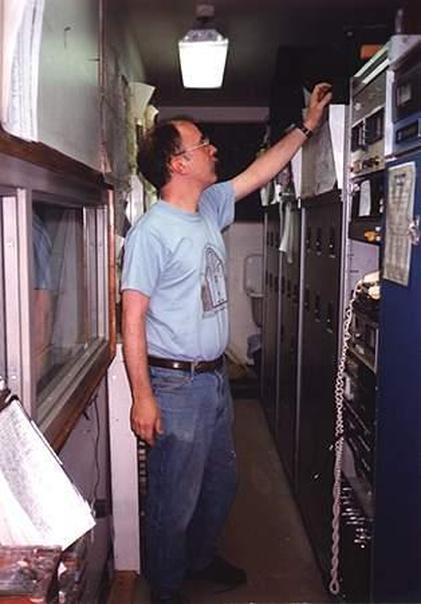
 So does anybody write or read these things anymore?
I’m going through one of these phases where I’m re-inventing my life, something I haven’t done since I was in my 20s, so I’m a little out of “practice.” One is not always in control of where life is headed, and at my age, in some ways you would think it would be easier, but the reality is it’s NOT as easy. To a degree, there are financial pressures that didn’t exist when I was younger.
Also, I can’t take many jobs because I am regarded as over-qualified.
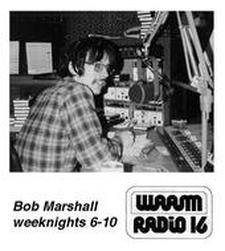
Actually, I once applied for work at a station in Howell, Michigan, when I was still in my 20s and in my last days as Production Director at WAAM. They even said I was “over qualified” back then. The reality is they were familiar with my background and felt they couldn’t afford me. They never say things like this, but I’m certain that was the reason.
Usually, you’ll get automatically rejected without being considered. That also happened to me at larger radio stations, too. The fact is back then, if they had given me a “shot” at whatever they could afford to pay me, I would have taken their station to a new level of performance.
Luckily, there have been many people who HAVE given me a “shot” since then and I turned it into a long-term deal, which I felt was mutually beneficial. Jack Bailey, then General Manager of WCAR said “If I find someone who is better qualified that you, would you mind if I laid you off and hired them instead?”
That seems kind of unfair, but to an extent, I appreciated that brutually honest question. The fact was, I gave him ten years of my best efforts as Chief Engineer and I was in fact, the best choice for that job.
In fact was still there after he resigned. The fact was after a couple years, I had won the guy over with my loyalty.
I BEGAN IN THIS BUSINESS OF RADIO during a simpler time.
By then I had experimented a lot on my own and had learned what I felt I needed to finally get paid. At first, I didn’t care what I got paid as long as it was something.
Sometimes it was tough, but mostly it was fun.
I taught myself almost everything. That doesn’t work for everyone, but it does for me. Eventually you accumulate enough knowledge that you can command a higher “price” for your presence.
Usually, some form of educational certification documents the knowledge you supposedly have. I chose to be different. While I did graduate from high school, I later developed a track record of years of industry experience. I had a practical hands-on approach, and it became my career. It doesn’t work for everyone and maybe it prevented me from applying for certain jobs, but I decided I didn’t want those kind of jobs anyway. Or perhaps I was just young and foolish, but I was working full time in broadcasting, so what did it matter!?
What I had studied and established on my own would be my long-term career savior though.
So what’s next? Your guess is as good as mine. The specifics are still “in development.”
Stay tuned… for the future!
BRC BROADCAST SERVICES
P.O. BOX 158
DEARBORN HEIGHTS, MI 48127-0158
This of course, is Bob’s BRC BROADCAST update!
My world consists of everything broadcasting and audio, past and present.
PRESENT DAY RADIO…
I remain an Engineer at Specs Howard School in Southfield (now part time). A lot of details of my life have changed as a result of this status. For example, I’ve become more active with Southfield Public Schools’ WSHJ-FM, where I am the designated Chief Engineer, and there’s a small resurgence of my “old-time” radio interests.
 THIS BLOG SITE WILL CONTINUE IN A LIMITED CAPACITY.
My former co-worker, and former Marketing Manager at Specs Howard, Shelly Maki was mostly to blame for setting this up and giving me the first nudge for creating some content. Shelly was a bright spot at Specs and a creative dynamo! So thanks Shelly for that “nudge” and for being who you are. You are missed.
If I’m half-way-decent at what I do, I always attribute my best work to the people who I’ve been lucky enough to work with. They don’t necessarily have to TEACH me anything – sometimes just a
hint of encouragement is all it takes. Or if they have an idea or particular style I like, I will sometimes borrow it and try to make it even better. This list of people for me has gotten too long to list. Sometimes they come back from the past to re-visit. That continues to happen. When it happens, I realize how important they were and perhaps still are. TOPICS TOPICS TOPICS!You gotta have topics for a radio show or a blog site. I’ve been in radio in some form for all my adult life, but I have a lot of opinions and thoughts on other more mainstream stuff as well. I’m not sure what my next hot topic we’ll be. Perhaps readers can suggest one. SUPPLEMENT #3 (old-time radio) FOR 2012 IS READY. Copies are available from my Facebook site: Facebook.com/bobdoesradio It includes Kraft Music Hall with Al Jolson, Suspense, Sherlock Holmes, Jack Benny and others. All shows are recently re-mastered to digital formats. HISTORY: BRC was begun as a mail order business by Bob Burnham in about 1976. We originally offered reel to reel and cassette tapes of old-time radio shows to the general public. The logo, in use for over 20 years, resembles a fully restored 1936 Atwater-Kent model 356 “tombstone” style radio which is in our office. I’m is also a broadcast engineer “at large” based in Detroit. NAME CHANGE: BRC PRODUCTIONS is now BRC BROADCAST SERVICES! This applies to ordering all old-time radio or nostalgia products and services. This became effective June 2012. OLD WEBSITES TAKEN DOWN: All past websites are No Longer Active. This includes both brcradio and brcproductions. CURRENT DOMAIN: Still active is brcbroadcast however, there is NOT yet a website behind the e-mail. E-MAIL CONTACT: You may contact us at [email protected]. NO FAX OR VOICE: We have also discontinued past fax and business office numbers. MAILING LIST: We snail mail printed old-time radio supplements about four times per year. We can also e-mail via .pdf format. There is no cost, however, we appreciate an occasional order. FREE SHOWS: BRC Broadcast maintains a free public dropbox from which free shows or other special audio can be obtained. Although complete shows may be included, these are intended as samples to our CD or mp3 products. DROPBOX: Links will be provided as they are added. There is no cost or obligation to playing or downloading any of these shows. Click on any link to access. Some of the free audio currently available is: https://dl.dropbox.com/u/19032620/Suspense%20excerpt.mp3https://dl.dropbox.com/u/19032620/AU_REVOIR_SHOW_CLOSE_Ben_Bernie.mp3https://dl.dropbox.com/u/19032620/SUSPENSE_301_08-05-1948_An_Honest_Man_Charles_Laughton.mp3https://dl.dropbox.com/u/19032620/SUSPENSE_741_03-09-1958_The_Chain.mp3CONVENTIONS: Periodically, we make product available at a reduced price at selected conventions. Those conventions are determined on an individual basis and may change from year to year. This will be announced in our supplements. SPECIAL REQUESTS: Although we maintain an archive of over 15,000 of the most popular (and not so popular) shows, we do not generally do custom recording. This is due to the multi-step digital restoration process that all shows are given before they are made available.
BY BOB BURNHAM...This was originally published in RADIO GUIDE in 2006. The intent was not to ignore the work of DeForrest or Tesla, but to put a different twist to what Thomas Edison did before them. 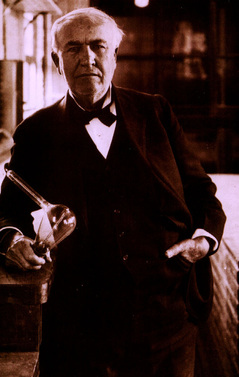 Thomas Edison is not a name most people associate with radio or broadcasting in general. We immediately think of the phonograph and electric light as the Edison inventions that made him famous and (rightfully so) wealthy as well. But this hardly tells the story of the thousands of patents, his relentless pursuit of success and how his very nature affects everyone alive today -- whether they work in broadcasting or not.
I've always had a curiousity about Edison's work and its products. A recent renewal of this interest led to further research. Although some historians may dispute this, it was soon realized that had Edison lived an extra 10 years, as far as radio was concerned, DeForrest, Faraday and Marconi may actually have been completely in the shadows of Thomas Alva Edison.
Dearborn, Michigan is the home of "The Edison Institute," also known as "Greenfield Village." This is a large collection of historical buildings and artifacts assembled originally by Edison's good friend, Henry Ford, hence the Museum and "village" today are simply referred to as The Henry Ford.
In the past, the Museum area had a fine collection of old radios and early transmitting apparatus. Today,
the most interesting part, however, is the "village" area.
Here, Edison's original Menlo Park laboratory buildings stand fully restored and maintained. Henry Ford painstakingly moved the Edison buildings to the site in 1929. Also included is Edison's early generating plant, among many other buildings.
The restored buildings contain most of the original equipment also moved from the original New Jersey site. Today, employees or "Presenters" at The Henry Ford provide a wealth of knowledge on Edison or other topics applicable to the buildings in which they are stationed. Here, my interest in Edison was re-ignited, and led to reading Paul Israel's extensive 560 page biography on the man, "Edison: A Life of Invention." The front cover of Israel's book shows Edison clutching his patented "Edison Effect" tube. Lee DeForrest, in fact, based his development of the vacuum tube on this device.
A few radios were actually later manufactured with Edison's name prior to his passing in 1931. Edison himself, however, felt the latest perfections to his PHONOGRAPH would become the leading home entertainment source. He thought radio would never catch on, but reluctantly agreed to produce an Edison combination radio-phonograph in 1928. It was not, however, a successful product. Competition from other manufacturers forced production to be discontinued a year or so later, but apparently not before he gave one away! In 1929, he held a national contest in which the prize was the scholarship to the University of ones own choosing, AND an Edison console radio (and toaster!). If that radio still exists somewhere, you can be assured it is worth more than most of us who work in radio today -- could afford. The study of the technology and tube types used in the late 1920's that may have been used by "Edison Industries" is another subject altogether, as the technology at that time was so very new. The DeForrest patent for the electronic tube in fact, had just been issued on January 29, 1929, a month AFTER the Columbia Broadcasting System was already incorporated!
Regardless, it is evident that Edison knew long before his death that his early work was, in fact, leading to the development of an industry, then in its infancy. He just didn't expect it to be radio! Much of his work, in fact, actually led to several industries IN ADDITION TO radio. One of the many spin-offs of Edison's original company, General Electric, is of course, legendary for its development of commercial radio.
It is fairly common knowledge that the vacuum tube and other concepts all crucial to practical broadcasting were all developed based on Edison's earlier work.
There are however, some notable though less obvious comparisons to Edison's work and ethics as well as his approaches to inventions that are identical to a typical broadcast engineer of today.
In order to understand, design, build or troubleshoot a complex studio or a complex piece of equipment, one must first understand each individual component. There must be a practical reason for each stage to exist and a functional or USER need for the device of combination of devices (as in a single piece of equipment) to exist as a whole.
Edison also thought about his individual inventions or devices as part of larger systems. He invented the first practical electric light, but realized it was of no value if it was not practical for everyone to use. He spent years developing methods to generate and distribute electricity. His company, in fact, was the first to construct power generating plants in the U.S. and other parts of the world. In southeastern Michigan, to this day, we are still writing checks every month payable to Detroit EDISON for our energy needs.
He developed a reputation in his youth as a master telegrapher (a form of broadcasting prior to radio). Many of us in broadcast engineering today began our careers as On-Air "jocks" before becoming Chief Engineers.
Edison would soon develop devices that would allow multiple transmissions to be conveyed over fewer wires, a means of printing telegraphy, and various repeaters that allowed transmissions over very long distances.
Think about how many satellite transponders exist in a single channel off a "bird." Or how many channels can be carried in a single fiber optic, or in an ISDN or T1 connection from a remote broadcast or to a transmitter site… on a single carrier or single pair of copper wires? For that matter, think about how many channels are available on your television through a single piece of coaxial cable.
For telegraphy (the communication method of the era with which Edison, as mentioned, was already an expert) Edison patented methods of doing this type of thing (conceptually) over copper long before radio or television. He was no slouch in business or self-promotion either. He gained respect and a powerful reputation early in his career. This meant major businesses of the era FINANCED his work.
One of his more interesting efforts was a means to transmit wireless from a moving railroad car.
A reed vibrating at 500 Hertz (or cycles per second as it was known then) was turned off and on with a telegraph key at the appropriate dot and dash interval. The "antenna" was the metal roof of the railroad car. Existing telegraph wires about 30 feet away served as a receiving "antenna." While this could probably best be described as a form of capacitive / inductive coupling, it was probably one of the very first successful wireless transmissions prior to DeForrest's work.
A broadcast engineer by necessity must know a little about EVERYTHING in the plant as well as the broadcast business itself. Of course, we can specialize in various areas, but among them had better be how to keep the station on the air.
Anyone who worked for Edison in later years had to pass an extensive test. It was comprised of many questions about the United States government and other seemingly unrelated issues to the job itself. It is said that Edison's own son could not pass the test. A website (which sadly no longer seems to exist) offered excerpts from the test. I couldn't answer even half the questions correctly, but if you wanted to work for Edison in the early 1900s, you had better be the absolute best in your field and know a little of everything about everything.
As to work ethics, Edison was known as a scrappy, competitive individual. He would work around the clock when certain projects were in a critical developmental stage. Who among us, has not pulled many "overnighters" building a studio, or working on a particular installation with absolutely no regard to time. Sometimes we forget to eat! The reward is seeing everything WORK just as designed, and seeing others benefit from that work. Hearing a morning show on the air the next day in a studio you just labored in for a dozen hours or more is a cool thing.
Thomas Edison was no different.
He was a workaholic, but he did have a soft side. He was deeply saddened by the death of his first wife. Having spent so little time at home, he actually felt guilty of his passion for his work. Perhaps arising out of this guilt, his daughter, then only 12 years old, became his laboratory assistant.
Even Edison's own health was a scientific experiment. He would eat only foods that completely agreed with his digestive system. Having lived to the ripe age of 84 in 1931, he must've been on the right track.
One favorite Edison quote…paraphrased and modernized:
"None of my inventions were accidents… they were the result of hard work" could probably also serve as a motto for broadcast technical personnel -- just replace the word "inventions" with "projects."
Think of someone (or a group of someones) who designed, licensed, built then successfully operated a complex directional AM array… when others thought it was not possible in that area.
An audience was served, people were delighted, the owner made profit… eventually. But it took a lot of steps and investment of blood, sweat and an especially large quantity of money.
But mostly it was hard work. VERY hard work.
Have you ever seen a AM ground system installed, towers erected, and done the footwork necessary to prove to the FCC that your equipment was operating as designed and not interfering with co-channels?
Or when someone delights in a shiny new digital studio, but perhaps takes it for granted, only a broadcast engineer KNOWS what it took to make it work as it does: hour upon hour if tedious wire stripping, drilling, crimping, soldering, pulling wires, etc.
Our personal technical successes in radio are NEVER EVER by accident!
They are ALWAYS the result of our HARD WORK.
Yet while there are plenty of us who know the meaning of hard work and some people in our industry who even approach the "genius" status, none can ever hope to have the profound effect Thomas Edison had on communications and the world.
(C) 2005 ROBERT BURNHAM
The equipment under my immediate supervision today is completely different than what it was 12-15 years ago. To a degree, I miss the transmitter, signal coverage and FCC compliance work. I was trained and have experience specifically in these areas. Over the years, I even became personally acquainted with our friendly neighborhood Detroit area FCC dudes!
Anyone who knows me, knows I thrive on variety. Working on the back-up power generator was not my favorite activity, but I didn’t MIND it. The same for taking a drive for the AM stations to grab "Monitor Points." None of this work was pleasant in the winter months, but it was part of what I did, and sometimes I actually did look forward to “Monitor Points” and listening critically to our station.
The most positive thing about the Chief Engineer’s job was variety. The board operators (a nearly extinct position), would have to endure my wrath when they messed up the log, forgot to take readings or missed the EAS test or an entry in the Tower lighting log. At one station, I was also on-air regularly. That was fun!
When there was a power outage during the winter months, I was always the one who could get the generator going and transfer the equipment over to the back-up circuits WITHOUT FAIL! If the transmitter or station went down for any reason, I could always get things “back,” again WITHOUT FAIL. There was no problem I couldn’t solve, and failure was actually never an option.
In the middle of winter, I once dug up frozen ground to repair a coaxial cable for the satellite receiver. BUT....by the end of the afternoon, we were “back” on the network.
Today, everything is dependant on computers, and while I am not an IT guy, I do have specialized knowledge about the software radio uses. At one time, I could even log in to the transmitter sites of various stations. If they were directional operations, I could verify the operating status of each tower, determine the operating power, transmitter status, and verify the station was “legal.” I no longer have that capability or responsibility, although to a degree, I have it on an automation system from my office.
So what will I be doing in another 15-20 years?
More of the same. I will not be “retired,” I will still be working I hope.
The computers of today will seem primitive
It is hard to predict, but. I will have soaked up much more IT knowledge as it relates to what I do. Perhaps I will have accomplished my lifetime goal, in which case I will be doing even more. AM broadcasting may have become obsolete and that AM knowledge I have will have no use, but all the Programming and audio processing knowledge will have to be unpacked and updated.
“Coverage” may be only a fixed function either of how tall the tower is, or how much bandwidth the audio server can handle.
Change is not always pleasant, or desired. But it is something we can always count on.
TECHNOLOGY THAT IS NOT PERFECTED
By Bob Burnham
I began my career in broadcasting in an analog world. Most of programming at that came from analog tapes, whether in cartridges or from reel to reel tapes. During my on-air years, those inventions had been around twenty or more years and were quite mature.
ANALOG RULED FOR MANY YEARS
Sure, there were issues with them and constant maintenance was necessary to achieve any level of quality and reliability. When we were able to do that, however, the quality and reliability was very high indeed for the standards of that time.
“KIND OF” BETTER
CDs were the first digital medium to come along and suddenly (with a couple of studio CD players) we were supposedly a “digital” station. That wasn’t REALLY true, of course, since the only digital piece of equipment was the player itself which output analog audio into an analog console feeding analog processing to an analog transmitter to analog radios.
But it was “kind of better.” There was no surface noise such as from a vinyl album, or hiss from tape. The recording industry, however, had not YET learned how to make good sounding CDs when they were first invented. Maybe some of us didn’t notice, although purists claimed they could hear the difference and still preferred the sound of vinyl albums to CD.
The broadcast industry did whatever it wanted. The mere convenience of not having to “cue up” a vinyl record or have the cart machine eat the tape seemed to make it worthwhile. As the CD equipment aged, however, we found out that CDs DO skip and sometimes they won’t play at all. That condition worsened when recordable CD equipment became more affordable.
NEW STUDIO PLAYERS A BIG DEAL
But I can assure you at our station, when we got Detroit Radio Legend, Deano Day to do mornings at our station, I got the approval to order bright and shiny new CD players for the main studio. It was kind of a big deal…both Deano and the equipment, that is.
The CD, however, had not been perfected and may never be perfected. Improved upon, yes, but the early claims that a commercially manufactured CD would last “forever” were flawed, and thw CD players themselves have a finite life.
PLAY AUDIO FROM FLOPPY DISC?!
Someone invented various types of digital “cart” players in an attempt to replace the analog carts that had been around since the 1960s.
The most laughable was the version that used computer floppy discs (remember them!?) as the medium. The problem was they could only hold about 2 minutes of audio. Most of us kept using analog carts. I had already developed a knack for re-winding higher grade tape into old cart tapes and replacing any worn parts. Our carts sounded great, and rarely jammed. I felt then, that the broadcast cart format was as good as it was ever going to get.
CONSUMERS HATE MD, BUT RADIO USED THEM ANYWAY
CD recorders were still too expensive. Sony, however, invented the recordable MiniDisc. Although it never caught on with consumers, broadcast stations embraced the format. Sony also manufactured various commercial grade MD players.
Hard drive based systems were still pretty expensive so many stations found they could replace cart machines with MD at a much lower price.
It wasn’t perfection, though. The MD format has inherent problems and limitations, although for the most part, sound wasn’t one of them. Sony got it right in that department, inventing their own proprietary audio compression for MD in 1992. It wasn’t MP3 or any of its predecessors. Sony called it “ATRAC” which stands for Adaptive Transform Acoustic Coding. WHATEVER! It was the key to how they were able to fit 80 minutes of stereo audio into a small optical disc, and still have it sound really good.
NO ESCAPING EVENTUAL FAILURE
Any removable media requiring a mechanical transport, however, will STILL have flaws. In a professional environment, mechanical devices will fail.
Meantime, computer-based hard-drive systems had gradually become more affordable and they became the standard. Stations threw their MD equipment in the dumpster whether it still worked or not.
HARD DRIVE BASED BROADCAST SYSTEMS
The earliest automation systems required a familiarity with Microsoft’s DOS command language. To record a cut, you had to make keyboard entries or hit an F key. Windows based systems and much more studio-friendly touch screens soon replaced the cumbersome early systems during the 1990s. Some of the earliest broadcast automation companies went out of business or were absorbed by the more successful ones,
Like any computer software, automation systems and versions were a constant work in progress. Sometimes version upgrades added many features and fixed problems, but brought along new problems. A stable version meant it could do everything you wanted without crashing or doing something else it wasn’t supposed to.
I wouldn’t say the automation technology is perfected, but it has come a long way in 20 or so years. In terms of reproduction quality, an automation system is capable of SOUNDING better than the tried and true CD format (that was invented in the 1980s).
But like the analog systems of the ancient past, it still needs to be correctly installed AND maintained on an on-going basis.
MECHANICAL PARTS STILL PRONE TO FAILURE
As in any system, the weak link is always the parts of the system that are still mechanical.
In the old days, in an analog cart, if the splice lets go, the tape will spill out into the machine and will appear to “eat” the cart.
In a computer-based system, if there is a hard drive spindle failure, an invading virus or any other kind of hard drive malfunction, the entire system will fail. In the cart machine days, you had only one machine down until the cart tape is replaced and the machine is cleaned. In the computer world, without a level of industrial back-up or redundancy, your station programming is off the air.
HOW PROFESSIONAL SYSTEMS IMPROVE INTEGRITY
In a broadcast world, multiple hard drives in various RAID configurations (Redundant Array of Independent Disks) are used. They spread (or mirror) the data across multiple hard drives. The system will continue to function even if there is an individual drive failure.
RAID technology is used extensively in other fields. There are a lot of other things that CAN go wrong, but this technology has probably reached a reliability level of the venerable cart machine of the analog days.
If one machine (or computer) goes bad in a networked environment, you can generally bring it up on another workstation and be “back” quickly.
The fact is, however, ALL technology is a work in progress. Each advancement whether hardware or software-based will have its positives and negatives. There will always be a way to “break” it or it can “break” itself.
PERSONAL EVOLUTION
My job evolved from the only guy on staff who knew how to load broadcast “carts” (and make them sound almost digital) to that of a multi-purpose digital hardware and audio software guy.
Many factors made my transition a fairly easy one (it was much easier and took a lot fewer years than evolving from a DJ to an Engineer).
DESIGNED & BUILT BY HUMANS BUT WITH CONSTANT NEED FOR ADVANCEMENT
But realize one thing: As advanced as we seem now, what we have is NOT perfected! 10 years from now, today’s hardware will be in the same category as a cart machine is today: Obsolete!
The fact is, however, "cart" machines were built like “tanks” to run forever! If you pulled one out of a dumpster today and plugged it in, it would probably still play. A discarded CD player, however, (with its all-plastic drawer, if it still opened) would probably just sit there and look dumb.
- Bob Burnham
September 24, 2011
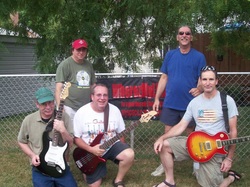 BACK TO BACK GIGS
When you don’t know where or how to begin, you simply begin at the beginning. That’s the way I approach every solo, and it usually works.
I am currently in two local Detroit area bands in addition to my daytime work. We all have daytime “non-band”work.
You would think because of their part-time nature, the two bands activities would be somewhat separated. All too often, however, “back to back” gigs DO occur.
Most of the people involved I’ve known for several years. Sometimes it takes a while to find enough of the right type of people for a correct “fit.” That can probably be said for any line of work, any organization or any “organized” activity.
“Back to back gigs” occurred during the second weekend of September 2011.
The media was all ablaze with the 10 year anniversary of 9/11. All I knew was I had to play two gigs back to back, including an extended outdoor block party.
I went into both not quite knowing what to expect. One group had recently lost some key members, and the “replacement” hadn’t quite settled in. The other group had not rehearsed for a couple months, and our lead guitar player was a no-show.
On the plus side, I had been doing the “band thing” quite a long time, and felt my contributions were fairly well covered. The fact I would be covering lead, rhythm AND bass for at least 3 hours didn’t really bother me either, except for the fact I knew I would be pretty well “spent” by the end of the festivities.
I was correct: It didn’t bother me, but I was pretty well whipped by the end.
The “other” group was different on the night before.
I explained to our newest band member that my function in bands had always been to support and make everyone else look better than perhaps they really were, or FELT like they were. I always play bass with that gang and as far as playing, pretty easy for me.
I am actually a little uncomfortable playing lead guitar, but due to the fabulous support of others surrounding me in the "other" band, proved I could actually do a passable job.
So our regular lead guitarist is a no-show at the block party; no big deal! The show must go on and if I know the parts reasonably OK, I will make it happen.
There’s a small part of us that sits in our experiences and people of the past. If I am half-way “decent” in providing that support, I credit a tiny bit of that “decentness” to those I’ve been associated with before. That is true of my daytime work as well.
Anybody who says music all comes from within, practicing solo with CDs, or sight reading music all day is mistaken. Perhaps that is a PART of the experience, but perhaps not the most important part. I have had intellectual discussions like this with other very talented people. I know what works for me when I have to “dig deep” and it’s not the same for everyone.
In short, it was a busy, somewhat exhausting but good weekend.
I am sure there will be more like it.
To my knowledge, there were no recordings or photos taken of any of it. You’ll just have to trust my descriptions!
--Bob
9/11/2011
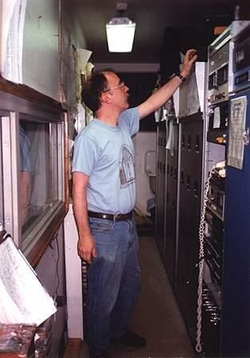 I always say I’ve been doing what I do “for a long time.”
So WHAT’S a “long time” ?? And WHAT in the world is “what I do” !??
The thing is I’ve compressed a lot of experience into my relatively “short” life. I say "short" because I still feel like a kid in a candy store surrounded by equipment and computers that didn’t exist when I first got interested.
I don’t know everything there is to know about the fields I work in, but I do know quite a bit…but it’s no big deal!
Yet in a sense, it IS a big deal. A professional bio of every staff member is published by my employer. Although my “fancy certificates” or diplomas are few and far between, describing my “industry experience” does take up a lot of space; much more than some of my colleagues who may have higher management positions.
I would almost say I’m actually embarrassed by how much space that bio takes! Except every line of it is totally true and it has actually been condensed and updated many times.
I also always say that during that “long time” I have worked with the absolute best people in THEIR specialty. That goes for the present, too.
I have been lucky to have been a “sponge” around people who are smarter than me, and took a little of their knowledge and experience and stuck it in the back of my brain.
I also have a very wide range of experience and interests, and my job is my hobby.
People with common professions or interests are my friends, and I learn something new on a daily basis thanks to them.
Life as a Broadcast Engineer who dabbles in the local music scene isn’t ALL fun and games though. Sometimes there’s actual work involved and it’s not a perfect world either.
But if you happen to come across that “LONG BIO” of mine in your travels across the internet, it’s not bragging! Not really, because I’ve lived through every single minute of those “adventures.” (You’ve probably had a few yourself I’d like to hear about.)
Meantime, I’m actually grateful to friends and co-workers who tap into MY brain on a daily basis.
It’s a cool thing being a resource to the best people in the industry for something I’ve done myself “for a long time.”
--Bob Burnham
08/02/2011
|