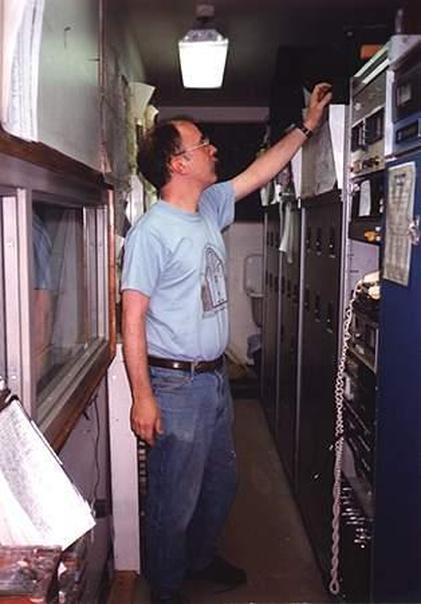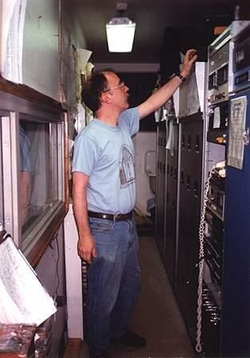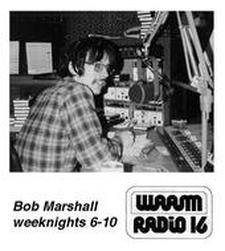
The equipment under my immediate supervision today is completely different than what it was 12-15 years ago.  To a degree, I miss the transmitter, signal coverage and FCC compliance work. I was trained and have experience specifically in these areas. Over the years, I even became personally acquainted with our friendly neighborhood Detroit area FCC dudes!

Anyone who knows me, knows I thrive on variety.  Working on the back-up power generator was not my favorite activity, but I didn’t MIND it.   The same for taking a drive for the AM stations to grab "Monitor Points."  None of this work was pleasant in the winter months, but it was part of what I did, and sometimes I actually did look forward to “Monitor Points” and listening critically to our station. 

The most positive thing about the Chief Engineer’s job was variety.  The board operators (a nearly extinct position), would have to endure my wrath when they messed up the log, forgot to take readings or missed the EAS test or an entry in the Tower lighting log.  At one station, I was also on-air regularly.  That was fun!

When there was a power outage during the winter months, I was always the one who could get the generator going and transfer the equipment over to the back-up circuits WITHOUT FAIL!  If the transmitter or station went down for any reason, I could always get things “back,” again WITHOUT FAIL.  There was no problem I couldn’t solve, and failure was actually never an option.

In the middle of winter, I once dug up frozen ground to repair a coaxial cable for the satellite receiver.  BUT....by the end of the afternoon, we were “back” on the network.   

Today, everything is dependant on computers, and while I am not an IT guy, I do have specialized knowledge about the software radio uses.  At one time, I could even log in to the transmitter sites of various stations.  If they were directional operations, I could verify the operating status of each tower, determine the operating power, transmitter status, and verify the station was “legal.”  I no longer have that capability or responsibility, although to a degree, I have it on an automation system from my office.

So what will I be doing in another 15-20 years?

More of the same.  I will not be “retired,” I will still be working I hope.

The computers of today will seem primitive

It is hard to predict, but. I will have soaked up much more IT knowledge as it relates to what I do. Perhaps I will have accomplished my lifetime goal, in which case I will be doing even more.  AM broadcasting may have become obsolete and that AM knowledge I have will have no use, but all the Programming and audio processing knowledge will have to be unpacked and updated.

“Coverage” may be only a fixed function either of how tall the tower is, or how much bandwidth the audio server can handle.

Change is not always pleasant, or desired.  But it is something we can always count on
.


Picture

TECHNOLOGY THAT IS NOT PERFECTED
By Bob Burnham
I began my career in broadcasting in an analog world.  Most of programming at that came from analog tapes, whether in cartridges or from reel to reel tapes. During my on-air years, those inventions had been around twenty or more years and were quite mature. 

ANALOG RULED FOR MANY YEARS 
 Sure, there were issues with them and constant maintenance was necessary to achieve any level of quality and reliability.  When we were able to do that, however, the quality and reliability was very high indeed for the standards of that time.

“KIND OF” BETTER 
 CDs were the first digital medium to come along and suddenly (with a couple of studio CD players) we were supposedly a “digital” station.  That wasn’t REALLY true, of course, since the only digital piece of equipment was the player itself which output analog audio into an analog console feeding analog processing to an analog transmitter to analog radios.

But it was “kind of better.”  There was no surface noise such as from a vinyl album, or hiss from tape.  The recording industry, however, had not YET learned how to make good sounding CDs when they were first invented.  Maybe some of us didn’t notice, although purists claimed they could hear the difference and still preferred the sound of vinyl albums to CD. 

The broadcast industry did whatever it wanted. The mere convenience of not having to “cue up” a vinyl record or have the cart machine eat the tape seemed to make it worthwhile.  As the CD equipment aged, however, we found out that CDs DO skip and sometimes they won’t play at all. That condition worsened when recordable CD equipment became more affordable.

NEW STUDIO PLAYERS A BIG DEAL 
 But I can assure you at our station, when we got Detroit Radio Legend, Deano Day to do mornings at our station, I got the approval to order bright and shiny new CD players for the main studio.  It was kind of a big deal…both Deano and the equipment, that is.

The CD, however, had not been perfected and may never be perfected.  Improved upon, yes, but the early claims that a commercially manufactured CD would last “forever” were flawed, and thw CD players themselves have a finite life.

PLAY AUDIO FROM FLOPPY DISC?! 
 Someone invented various types of digital “cart” players in an attempt to replace the analog carts that had been around since the 1960s. 

The most laughable was the version that used computer floppy discs (remember them!?) as the medium.  The problem was they could only hold about 2 minutes of audio.  Most of us kept using analog carts.    I had already developed a knack for re-winding higher grade tape into old cart tapes and replacing any worn parts.  Our carts sounded great, and rarely jammed.  I felt then, that the broadcast cart format was as good as it was ever going to get.


CONSUMERS HATE MD, BUT RADIO USED THEM ANYWAY 
 CD recorders were still too expensive.  Sony, however, invented the recordable MiniDisc. Although it never caught on with consumers, broadcast stations embraced the format.  Sony also manufactured various commercial grade MD players. 

Hard drive based systems were still pretty expensive so many stations found they could replace cart machines with MD at a much lower price.

It wasn’t perfection, though.  The MD format has inherent problems and limitations, although for the most part, sound wasn’t one of them.  Sony got it right in that department, inventing their own proprietary audio compression for MD in 1992.  It wasn’t MP3 or any of its predecessors.  Sony called it “ATRAC” which stands for Adaptive Transform Acoustic Coding.  WHATEVER!  It was the key to how they were able to fit 80 minutes of stereo audio into a small optical disc, and still have it sound really good.

NO ESCAPING EVENTUAL FAILURE 
 Any removable media requiring a mechanical transport, however, will STILL have flaws.  In a professional environment, mechanical devices will fail.

Meantime, computer-based hard-drive systems had gradually become more affordable and they became the standard.  Stations threw their MD equipment in the dumpster whether it still worked or not. 


HARD DRIVE BASED BROADCAST SYSTEMS 
 The earliest automation systems required a familiarity with Microsoft’s DOS command language.  To record a cut, you had to make keyboard entries or hit an F key.  Windows based systems and much more studio-friendly touch screens soon replaced the cumbersome early systems during the 1990s.   Some of the earliest broadcast automation companies went out of business or were absorbed by the more successful ones,

Like any computer software, automation systems and versions were a constant work in progress.  Sometimes version upgrades added many features and fixed problems, but brought along new problems.  A stable version meant it could do everything you wanted without crashing or doing something else it wasn’t supposed to.

I wouldn’t say the automation technology is perfected, but it has come a long way in 20 or so years.  In terms of reproduction quality, an automation system is capable of SOUNDING better than the tried and true CD format (that was invented in the 1980s).

But like the analog systems of the ancient past, it still needs to be correctly installed AND maintained on an on-going basis.

MECHANICAL PARTS STILL PRONE TO FAILURE 
 As in any system, the weak link is always the parts of the system that are still mechanical.

In the old days, in an analog cart, if the splice lets go, the tape will spill out into the machine and will appear to “eat” the cart.

In a computer-based system, if there is a hard drive spindle failure, an invading virus or any other kind of hard drive malfunction, the entire system will fail.  In the cart machine days, you had only one machine down until the cart tape is replaced and the machine is cleaned. In the computer world, without a level of industrial back-up or redundancy, your station programming is off the air.

HOW PROFESSIONAL SYSTEMS IMPROVE INTEGRITY 
 In a broadcast world, multiple hard drives in various RAID configurations  (Redundant Array of Independent Disks) are used. They spread (or mirror) the data across multiple hard drives. The system will continue to function even if there is an individual drive failure. 

RAID technology is used extensively in other fieldsThere are a lot of other things that CAN go wrong, but this technology has probably reached a reliability level of the venerable cart machine of the analog days.

If one machine (or computer) goes bad in a networked environment, you can generally bring it up on another workstation and be “back” quickly.

The fact is, however, ALL technology is a work in progress. Each advancement whether hardware or software-based will have its positives and negatives.  There will always be a way to “break” it or it can “break” itself. 

PERSONAL EVOLUTION 
 My job evolved from the only guy on staff who knew how to load broadcast “carts” (and make them sound almost digital) to that of a multi-purpose digital hardware and audio software guy.

Many factors made my transition a fairly easy one (it was much easier and took a lot fewer years than evolving from a DJ to an Engineer).

DESIGNED & BUILT BY HUMANS BUT WITH CONSTANT NEED FOR ADVANCEMENT 
But realize one thing: As advanced as we seem now, what we have is NOT perfected!  10 years from now, today’s hardware will be in the same category as a cart machine is today: Obsolete!

The fact is, however, "cart" machines were built like “tanks” to run forever! If you pulled one out of a dumpster today and plugged it in, it would probably still play. A discarded CD player, however, (with its all-plastic drawer, if it still opened) would probably just sit there and look dumb.

- Bob Burnham
  September 24, 2011


Picture
BACK TO BACK GIGS
When you don’t know where or how to begin, you simply begin at the beginning.  That’s the way I approach every solo, and it usually works.

I am currently in two local Detroit area bands in addition to my daytime work.  We all have daytime “non-band”work. 

You would think because of their part-time nature, the two bands activities would be somewhat separated.  All too often, however, “back to back” gigs DO occur.

Most of the people involved I’ve known for several years.  Sometimes it takes a while to find enough of the right type of people for a correct “fit.”  That can probably be said for any line of work, any organization or any “organized” activity.

“Back to back gigs” occurred during the second weekend of September 2011.

The media was all ablaze with the 10 year anniversary of 9/11.   All I knew was I had to play two gigs back to back, including an extended outdoor block party. 

I went into both not quite knowing what to expect.  One group had recently lost some key members, and the “replacement” hadn’t quite settled in.  The other group had not rehearsed for a couple months, and our lead guitar player was a no-show. 

On the plus side, I had been doing the “band thing” quite a long time, and felt my contributions were fairly well covered.  The fact I would be covering lead, rhythm AND bass for at least 3 hours didn’t really bother me either, except for the fact I knew I would be pretty well “spent” by the end of the festivities.

I was correct:  It didn’t bother me, but I was pretty well whipped by the end.

The “other” group was different on the night before.

I explained to our newest band member that my function in bands had always been to support and make everyone else look better than perhaps they really were, or FELT like they were. I always play bass with that gang and as far as playing, pretty easy for me.

I am actually a little uncomfortable playing lead guitar, but due to the fabulous support of others surrounding me in the "other" band, proved I could actually do a passable job.

So our regular lead guitarist is a no-show at the block party; no big deal! The show must go on and if I know the parts reasonably OK, I will make it happen.

There’s a small part of us that sits in our experiences and people of the past.  If I am half-way “decent” in providing that support, I credit a tiny bit of that “decentness” to those I’ve been associated with before.  That is true of my daytime work as well. 

Anybody who says music all comes from within, practicing solo with CDs, or sight reading music all day is mistaken.  Perhaps that is a PART of the experience, but perhaps not the most important part.  I have had intellectual discussions like this with other very talented people.  I know what works for me when I have to “dig deep” and it’s not the same for everyone.

In short, it was a busy, somewhat exhausting but good weekend.
I am sure there will be more like it.
To my knowledge, there were no recordings or photos taken of any of it.  You’ll just have to trust my descriptions!

--Bob

 9/11/2011


Picture
I always say I’ve been doing what I do “for a long time.”

So WHAT’S a “long time” ??  And WHAT in the world is “what I do” !??
The thing is I’ve compressed a lot of experience into my relatively “short” life.  I say "short" because I still feel like a kid in a candy store surrounded by equipment and computers that didn’t exist when I first got interested.

I don’t know everything there is to know about the fields I work in, but I do know quite a bit…but it’s no big deal!

Yet in a sense, it IS a big deal.
  A professional bio of every staff member is published by my employer.  Although my “fancy certificates” or diplomas are few and far between, describing my “industry experience” does take up a lot of space; much more than some of my colleagues who may have higher management positions.

I would almost say I’m actually embarrassed by how much space that bio takes!  Except every line of it is totally true and it has actually been condensed and updated many times.

I also always say that during that “long time” I have worked with the absolute best people in THEIR specialty.  That goes for the present, too.

I have been lucky to have been a “sponge” around people who are smarter than me, and took a little of their knowledge and experience and stuck it in the back of my brain.

I also have a very wide range of experience and interests, and my job is my hobby.

People with common professions or interests are my friends, and I learn something new on a daily basis thanks to them.

Life as a Broadcast Engineer who dabbles in the local music scene isn’t ALL fun and games though.  Sometimes there’s actual work involved and it’s not a perfect world either. 

But if you happen to come across that “LONG BIO” of mine in your travels across the internet, it’s not bragging!  Not really, because I’ve lived through every single minute of those “adventures.”  (You’ve probably had a few yourself I’d like to hear about.)

Meantime, I’m actually grateful to friends and co-workers who tap into MY brain on a daily basis.

It’s a cool thing being a resource to the best people in the industry for something I’ve done myself “for a long time.”  

--Bob Burnham
    08/02/2011


Picture
MARKETING: CRUCIAL TO ANY VENTURE (A “niche” business takes extra creative energy)

June 12, 2011

By Bob Burnham


Marketing is at the core of what makes any business survive or die.

I know this from first hand experience.

It the world of old-time radio, many years ago, it could’ve been something as simple as copies of a hand-typed list of shows available on tape for a negligible cost…snail-mailed.

Today, “simple” doesn’t work and hasn’t worked for a very long time.

People are more sophisticated.  If I stop marketing, the business stops. Period.  A big slick catalog that cost thousands of dollars to produce doesn’t work either.  People throw away catalogs. 

If they want to look at a LOT of content, they will go to the website.  That’s what I do whenever I need something… ANYTHING!

As far as audio content, they will either stream it or download it for later consumption probably on a portable device.  This is how MOST entertainment and music is marketed

Old-time radio fans, however, ARE different in the traditional sense (at least the hard-core ones, and not the youngest listeners).  They still like the physical media.  They will still respond to something physical on paper.  The newer ones may respond to something e-mailed to them. 

CHANGES…FORCED OR NOT
Who writes checks anymore?  The people who responded to a PRINTED piece will write checks.  Further, almost single-handedly, hearing screaming and yelling, I was able to convert those with large audio cassette collections to the more practical (and cost effective to produce) audio CD while others went directly to the mp3 data disc.

Both formats, however, are now completely obsolete as far as the rest of the world is concerned. An entire collection can now be acquired without waiting for anything in the mail, writing a check, or touching physical media (such as a disc or tape).  That entire collection can be played directly on the device that downloaded the audio, moved to another more portable device, or “streamed” to devices in your home.  There’s no tape heads to clean, racks of jewel cases to contend with, or bookshelves full of boxes reel to reel tapes….EXCEPT for people like me who are constantly transferring content of older media to digital electronic formats.

AUDIO FROM “SOMEWHERE”
Old-time radio from “The Clouds” is merely another way of saying shows are stored somewhere on the public internet. 

One can get anything about anything on the internet.  Tens of thousands of full length movies, television shows, music of every imaginable genre are all downloadable sometimes for a fee, but sometimes completely free.

Those of us (who in a previous decade) acquired huge accumulations of old-time radio are trying valiantly to keep up with the rest of the world by copying our old reel to reel tapes to digital formats.  None of us will live long enough to complete the task even on an individual basis, but we will get a lot done in the meantime (and I personally will let you know which titles are coming out as they are re-mastered!).

We do not, however, have the financial backing of major media or motion picture people financing our efforts.  Because of this, it takes longer than some people would prefer.  Fortunately, the cost of physical storage devices like hard drives is constantly dropping.

MARKETING STIRS UP INTEREST & DOLLARS
For me, Marketing old-time radio is still my source of financing for that part of my business.  It is at the core of what allows me to do what I do.  Marketing also takes time, creative energy, and yes, there is a cost involved to marketing itself.

I’ve tried most forms of marketing, and for a niche product (like old-time radio), it’s an aspect you have to keep re-inventing.  There is no “tried and true” approach or method in the year 2011.  But…the more you keep trying, the greater your chance of success, especially if you land on something that IS successful.

If you stop or give up, or become discouraged too easily, the response WILL stop almost immediately.  People don’t really save old mailings nor do they re-visit a spot on the web if you don’t give them a reason to do that.

THE BOTTOM LINE OF MARKETING SUCCESS
Successful marketing is merely offering a product THEY want at a TIME they want it, for a PRICE they’re willing to pay.  Of course, the product must be cost effective to produce.  They MAY return to you for more only if you delivered a good experience for them.  

My “good experience” starts with a good product, developed from a lifetime of collecting old shows from good sources.  I use professional-grade hardware, including several custom-built computer workstations.  I rely on software from Adobe for both the audio itself and the Creative Suite and FileMaker database software for marketing.

Picture
The core concepts behind the marketing are the same, however, if I was still running cassette decks, a rack full of sound equipment, and IBM typewriters, I would not be competitive.  

The other part of “good experience” is customer service.  Many businesses over-look this crucially important aspect.  If one constantly works toward being the best, they develop a good reputation.  I am happy to say I’ve managed to achieve a decent reputation.

When friends of mine in the old-time radio business complain business is not what it once was, I’m working on my next promotion and enjoying some success.

Marketing to a business IS a major part of success, but so is ATTITUDE! 

This is your new blog post. Click here and start typing, or drag in elements from the top bar.


Picture
So how are things in my bands going?

June 10, 2011
By Bob Burnham
I am a Broadcast Engineer and a Detroit area musician.

The bands I’m in and those involved have been the victims of the economy.  Most of us are surviving on a personal level, but paying work for “your local band,” no matter how great they (the band) may be, is fairly rare these days (at least so I’ve been led to believe). 

More than that, those of us who in the past spent time “pounding the streets” for band work are NOW  a.) spending more time at the day job, b.)  have taken a second job or c.)  having other personal problems, or (of course) any combination of the above.

People in bands also become discouraged when the band commits to too many “freebies” that lead nowhere and the band seems to be in forever in a passive mode.  The set-list seems to be frozen in time.  The best way to get the best out of any performer is to help them feel good about themselves.  I’ve spent a lifetime doing this at various levels, also as a former studio owner.  When band members are bored or discouraged, they will  not be at their “best:” In fact, they will be at their absolute worst. I've been on both sides of that fact.

There are two reasons I play music in addition to being a broadcast engineer:   Fun and Money. The two go together.  If it’s not FUN it damn well better be putting some money in my pocket!

When it IS a lot of FUN, anyone can survive as an actively playing musician when they have a daytime non-music profession.  With no money, when it Ceases to Be FUN, I stop doing it, or at least move on to another project with people who ARE having FUN and making some money.  

I’ve managed to have FUN for a as an actively playing Detroit area musician for decades, however, that music FUN has started to fade. 

If it’s PAYING music work, the tolerance level may be extended a little longer, but without the FUN-factor, it won’t last..

But for me, the real “PAY” is that “religious experience” or “magic” we make when we play music and we are all in synch to each other. 

In some ways, music IS my religion.  NOT everyone is up to that “magic” level, but those that are, that I’ve worked with – know who they are.

Will we ever get back to prosperity?

Will people NOT be burned out on life and living, and playing the same songs over and over, and in a passive mode for (on top of that)  NO Money?

I don’t have the answer to that, but in the meantime, I have a lot of stuff to accomplish.

I AM inherently optimistic and still look forward to making more “magic” on a daily basis and at least one more time playing music tonight
(where I promise to give 110% no matter what).

----Bob B